From the passage you can’t get right to the exercise that fixes it.
Add the piece you’re studying and Violin Brain tells you which technique to work on and with which exercise. For intermediate and advanced violinists.
Free 2-minute test · no card required
or create your account without the quiz →- The pieceCaprice No. 10 · Paganini
- The techniqueSolid staccato
Bow mechanics · contact point · index-finger pressure
- The exerciseFiorillo · Étude No. 3
Controlled staccato, step by step
A methodological assistant for serious violinists.
Violin Brain brings your repertoire, technique, methods, and progress together in one place, and connects them.
It’s not a planner or a generic productivity app: it’s built from violin pedagogy, by a violinist.
You know where you stand, where you’re headed, and what’s missing to get there. Practice stops being a blind routine and becomes progress you can see.
Why do advanced violinists plateau?
- Before
No structure
You practice for hours, but nothing connects what you study to what you need to improve.
With Violin BrainPlan
Set your goals and organize today’s session into blocks. With the Study Mode timer, every minute is logged and earns coins.
- Before
Not knowing which exercise fixes your passage
You know the passage isn’t working, but not which technique to study. You repeat it instead of solving it.
With Violin BrainSolve
The Technical Brain shows you the technique your piece needs (spiccato, vibrato, position shifts) and the exact exercise in Kreutzer, Fiorillo, or Ševčík.
- Before
No visible progress
Your effort leaves no trace: no record, no evolution. Just hours passing by.
With Violin BrainTrack
Jot down corrections without stopping. Your notes, repertoire, and hours are saved: your progress, in plain sight.
Your week in the dashboardExample - this week
- 4 h 40 min
- coins earned
- 48
- day streak
- 7
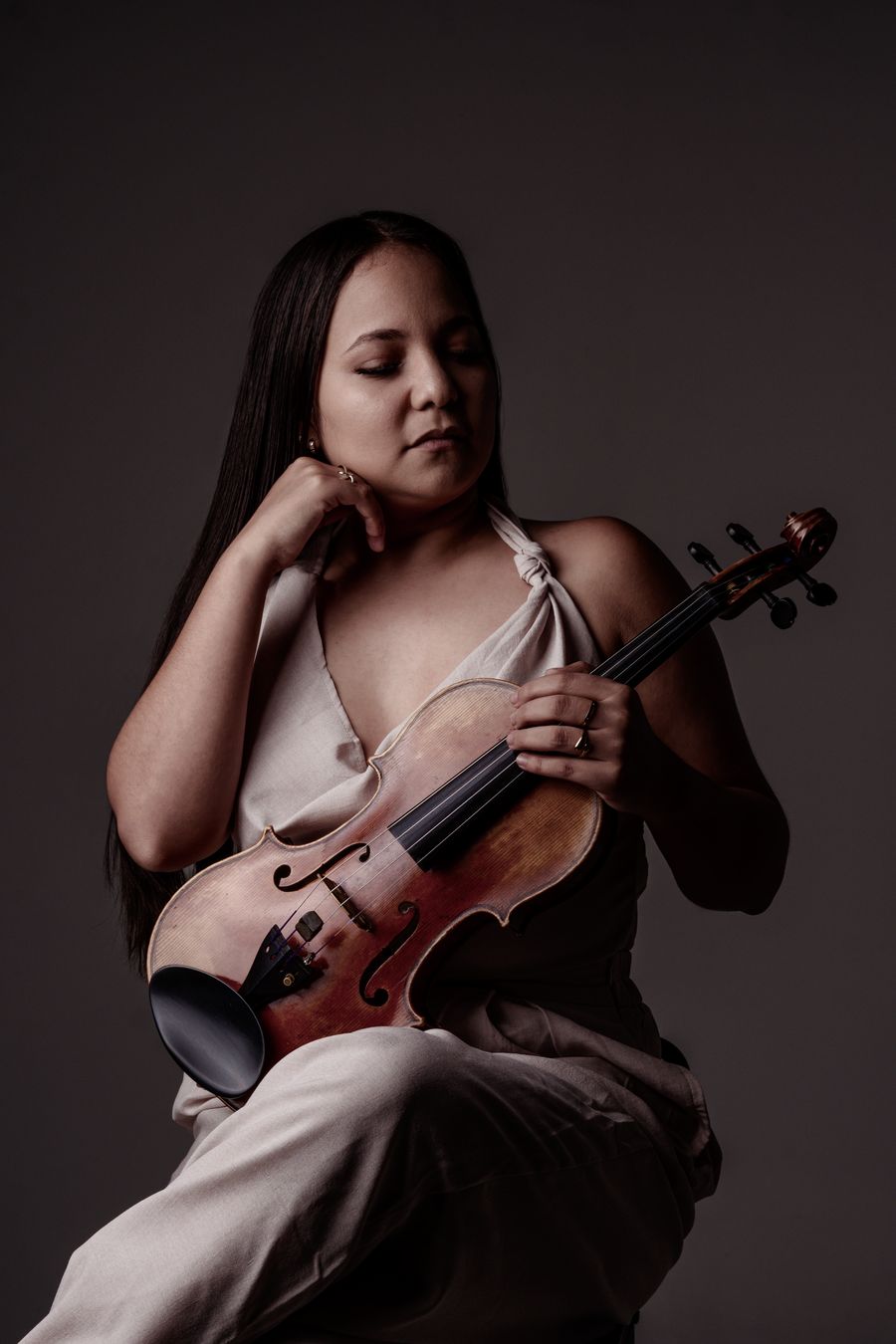
Génesis Antonetty
Violinist · Founder of Violin Brain
- 8 years with the Simón Bolívar Symphony
- Recorded at Abbey Road for Deutsche Grammophon
- Grammy-nominated recording
What kind of violinist are you?
Ten questions. One profile. Exact recommendations for you.
What’s your biggest challenge in daily practice?
From the piece to the exercise. In three steps.
The piece
Add the piece you’re studying and see which techniques it demands and the role each one plays.
Caprice No. 10
Niccolò Paganini
Techniques it demands
- Solid staccato
- Trills
- Fingered octaves
- String crossings
- Chords
Solid staccato: The main rhythmic engine; it sets the energetic character from the very first bar.
The profile
Open the profile of the technique that isn’t working: what it is, how it should sound, and the common mistakes.
Solid staccato
Right hand
What is it?
A series of short, clearly separated notes within a single bow stroke, with the hair in constant contact with the string.
- Tone goal
- Technical principles
- Common mistakes
- Progressive exercises
- Suggested routine
The exercise
And land on the exact études that train it, starting with Fiorillo No. 3.
Where to study this technique
Fiorillo6 études
- 3
- 6
- 16
- 18
- 25
- 33
Kayser4 études
- 18
- 26
- 27
- 33
Kreutzer3 études
- 4
- 28
- 36
and more in Rode, Mazas, and Dont
Choose your level of depth.
Creating your account is free, no card required — this is what membership looks like when you want more.
then $12/mo
The system, in your hands.
- Study Mode with a timer: coins are earned by practicing
- Repertoire, goals, notes, and study plan
- Monthly challenges and coin shop
then $25/mo
From scattered technique to directed technique.
- Everything in Copper
- Technical Fundamentals: one technique mastered per week, from the bow to the left hand
- Method Finder: 400+ lessons connecting every difficulty to its exercise
- Paganini’s Caprices, technical resources, and the Sheet Music Library
Direct mentorship.
- Everything in Copper and Silver
- A custom study plan
- Three 60-minute 1:1 lessons a month
What people already studying with the system say.
“Si eres un violinista que busca organizar tanto su estudio como sus objetivos, Violin Brain es para ti. Te brindará una estructura sobre la cual cimentar tu práctica y te llevará, paso a paso, a construir la solidez técnica y musical para que te conviertas en el violinista de tus sueños. Te brinda, en un solo lugar, herramientas que te llevan a seguir tu progreso real y trabajar en tus puntos débiles para potenciarlos. Todo esto con el acompañamiento de una violinista con años de experiencia en este sistema y años de resultados demostrables.”

“Me encantó. Me ayudó a reorganizar mi visión al momento de estudiar con mi instrumento, además de servirme de guía para establecer objetivos de una manera realista y alcanzable para avanzar de manera sólida en mi estudio individual. Es una herramienta muy útil y motivadora.”

“Mi experiencia con Violín Brain ha sido excelente. Es una herramienta fantástica para organizar el estudio individual de mi repertorio. Lo que más destaco es que, dentro de las sesiones (ya sea para escalas, estudios o conciertos), te permite realizar anotaciones y correcciones muy puntuales sobre lo que necesitas mejorar. Esto me parece fundamental, ya que facilita un trabajo mucho más enfocado para la siguiente práctica. Al final, la clave de un estudio realmente efectivo es el enfoque, y llevar este registro hace que todo el proceso sea muchísimo más fácil y organizado.”

“Me encantó el sistema, me ayudó mucho en la concentración al practicar y tambien du buscador de métodos se me hace muy útil para trabajar detalles de mi tecnica, me encantó⭐️”
“Es una aplicación demasiado buena que te incentiva a estudiar dia con dia y a crear ese hábito de disciplina diario, mas aparte tiene apartados muy buenos para mejorar considerablemente dia con dia 1 golpe de arco por cada semana. Los incentivos del poder ganar monedas con el tiempo que estudies son buenísimos, el poder tener una clase con un maestro solo por haber acumulado monedas esta buenísimo, super recomendada.”
Génesis Antonetty is a Venezuelan violinist. With the Simón Bolívar Symphony Orchestra she has played halls such as the Berlin Philharmonie and the Philharmonie de Paris, and she took part in a Grammy-nominated recording conducted by Gustavo Dudamel. She has taught since 2021, and Violin Brain grew out of the system she studied with herself: every technical problem, connected to the exercise that solves it.
Your next hard passage already has an exercise.
Create your free account, no card needed: you get 5 days of practice to try it.
Not ready yet? Leave your email and I’ll let you know when there’s news about the system.
No spam. Just updates about the system; to stop getting them, reply STOP. Privacy policy